
Test vs Exam vs Assessment — The Difference Actually Matters (Here's Why)
Test vs exam vs assessment — they are not the same, and the difference determines which security level your institution actually needs. Full comparison table, examples, and MonitorExam configuration guide.
Updated July 9, 2026 · 10 min read · MonitorExam
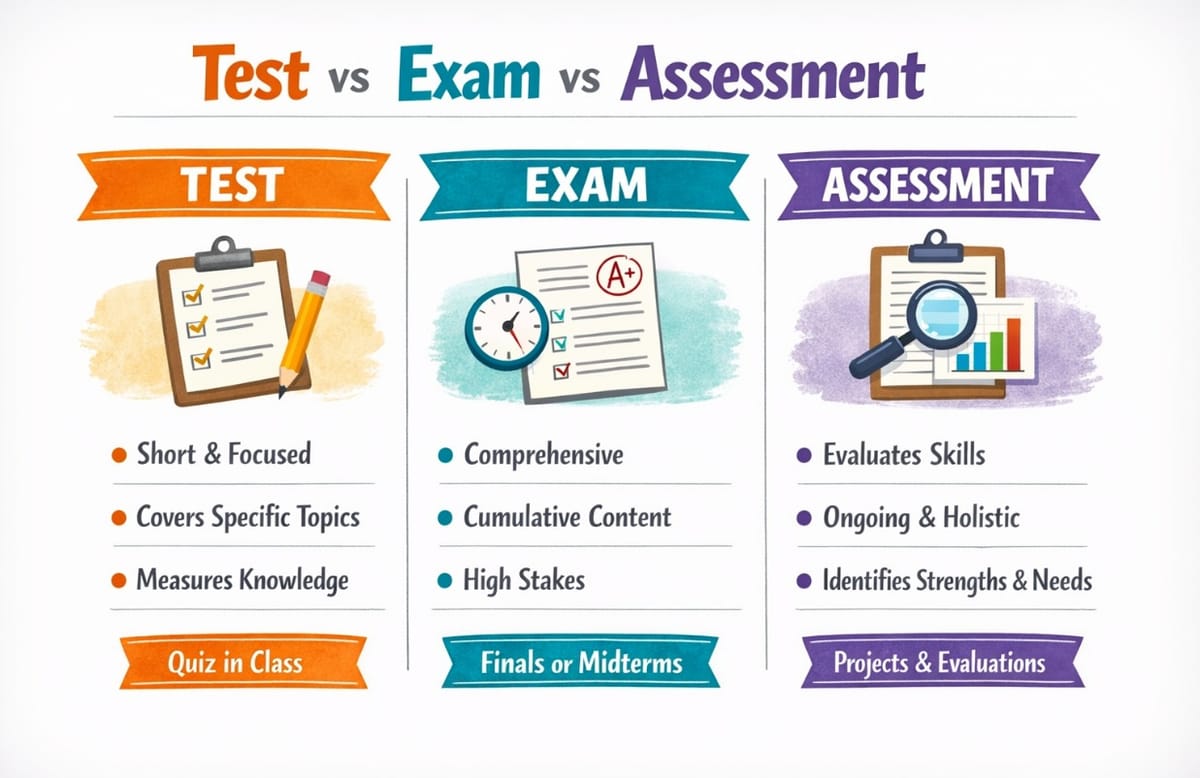
⚡ Quick Answer A test is a short, low-stakes evaluation of specific knowledge. An exam is a formal, high-stakes assessment at the end of a learning period. An assessment is a broad, ongoing process that measures learning through multiple methods. They are not the same — and using the wrong one for the wrong purpose affects both learning outcomes and exam security.
Exam — Definition
An exam is a formal, high-stakes evaluation used to certify that a student has achieved the required standard in a subject, course, or programme. Exams are invigilated, timed, and summative — they measure what has been learned at the end of a learning period, not during it.
| Exam attribute | Detail |
|---|---|
| Stakes | High — affects grade, certification, or progression |
| Scope | Full course, semester, or programme |
| Timing | End of learning period |
| Duration | 1–4+ hours |
| Format | Structured, fixed questions |
| Invigilation | Usually required |
| Purpose | Certify achievement |
Common exam types: Final semester exams, board exams, entrance exams (JEE, GMAT, GRE, SAT), professional licensing exams (USMLE, Bar exam, ACCA, CFA).
Need to run a secure exam? Try MonitorExam Free → — no installation, no credit card, works with Google Forms.
What Is an Exam?
An exam is a formal, high-stakes evaluation conducted at the end of a course, semester, or programme to certify whether a student has achieved the required learning outcomes. Unlike a test — which monitors progress — an exam determines outcomes: a grade, a qualification, or a pass/fail decision that affects the student's future.
Exams are typically:
- High-stakes — results affect grades, progression, or certification
- Timed and structured — with fixed questions and a defined format
- Invigilated — conducted under controlled conditions to ensure integrity
- Summative — they evaluate what has been learned, not ongoing progress
Examples: Final semester exams, board exams, entrance tests (JEE, GMAT, GRE, SAT), professional certification exams (USMLE, Bar exam, ACCA).
Best tools for exams: MonitorExam, Mercer Mettl
Learn more: How AI proctors detect cheating during online exams
What Is a Test?
A test is a shorter, more targeted evaluation of specific knowledge or skills — typically lower stakes than an exam and used more frequently throughout a course.
Tests are typically:
- Lower-stakes — used for feedback and grading checkpoints, not final certification
- Shorter — covering a unit or topic rather than an entire course
- Periodic — given weekly, monthly, or at the end of a unit
- Formative or summative depending on context
Examples: Weekly quiz, unit test, mid-term test, chapter test, mock test.
Best tools for tests: Google Forms, AssessME, JotForm, Microsoft Forms
Read: Can teachers detect cheating on Google Forms?
Exam vs Test: What Is the Difference?
The most searched question on this topic — and the answer most articles get wrong.
| Test | Exam | |
|---|---|---|
| Stakes | Low to medium | High |
| Scope | Specific topic or unit | Full course or programme |
| Frequency | Frequent (weekly/monthly) | Infrequent (end of term/year) |
| Purpose | Monitor progress | Certify achievement |
| Duration | Short (15–60 minutes) | Long (1–4+ hours) |
| Consequences | Grade contribution | Pass/fail, certification, progression |
| Proctoring needed | Optional | Usually required |
In short: A test checks if you're learning. An exam certifies that you've learned.
What Is an Assessment?
An assessment is the broadest of the three terms. It refers to any systematic process used to gather evidence about student learning — not just a single event but an ongoing, multi-method approach.
Assessments are:
- Continuous — not limited to a single point in time
- Multi-format — can include tests, exams, projects, observations, portfolios, and peer reviews
- Diagnostic, formative, or summative depending on purpose
- Focused on informing teaching as much as measuring learning
Examples: Course portfolio, continuous grading, classroom observation, standardised achievement testing, diagnostic pre-test.
Best tools for assessments: Google Classroom, Canvas, AssessME by MonitorExam
Explore: 5 types of educational assessments explained
Assessment vs Test: What Is the Difference?
| Test | Assessment | |
|---|---|---|
| Format | Single event | Ongoing process |
| Method | Usually written | Multiple methods |
| Purpose | Measure knowledge | Inform teaching + measure learning |
| Frequency | Periodic | Continuous |
| Feedback | Score | Diagnostic insights |
| Used by | Teachers for grading | Teachers + institutions for decisions |
Assessment vs Exam: What Is the Difference?
| Exam | Assessment | |
|---|---|---|
| Scope | Single high-stakes event | Broad, ongoing process |
| Stakes | High | Varies (low to high) |
| Format | Fixed, invigilated | Flexible, multiple methods |
| Purpose | Certify achievement | Measure and improve learning |
| Examples | Final exam, board exam | Portfolio, continuous grading |
Assessment vs Examination: What Is the Difference?
Examination is simply the formal word for exam — used more in British English and academic contexts. Assessment is broader. An examination is one type of assessment instrument.
A student may be assessed through multiple methods throughout a course — but examined only once at the end.
Difference Between Test and Examination
A test is informal and periodic — used regularly throughout instruction. An examination is formal and high-stakes — used at the end of a learning period to certify mastery. All examinations are tests, but not all tests are examinations.
Is an Assessment a Test?
Not exactly. An assessment encompasses many tools — tests, exams, observations, projects, and portfolios — and refers to the overall process of gathering evidence about learning. A test is a specific instrument used within that process.
Think of it this way: assessment is the system; a test is one tool within it.
Is an Assessment an Exam?
No — though they are often confused. An exam is a single high-stakes event. An assessment is a broader process that can include exams, but also includes ongoing, lower-stakes methods. A course assessment might consist of three tests, one exam, and a project — each contributing to the overall picture.
The Purpose of Exams
Exams serve four primary purposes in education:
- Certification — confirming a student has met the required standard to progress or qualify
- Selection — ranking candidates for competitive entry (university admissions, job placement)
- Accountability — measuring institutional performance against curriculum standards
- Motivation — creating structured milestones that encourage focused study
The higher the stakes of the exam, the more important it is to ensure integrity — which is why high-stakes exams require proctoring, identity verification, and controlled conditions.
Which Is Harder — a Test or an Exam?
Exams are generally harder than tests because they:
- Cover more material (full course vs single unit)
- Carry higher consequences (pass/fail vs grade contribution)
- Are less frequent (one chance vs multiple attempts)
- Are conducted under stricter conditions
However, difficulty depends on context — a challenging unit test can be harder than a straightforward final exam. The key difference is stakes, not content difficulty.
Quiz vs Test vs Exam vs Assessment
| Quiz | Test | Exam | Assessment | |
|---|---|---|---|---|
| Stakes | Very low | Low–medium | High | Varies |
| Duration | Very short (5–15 min) | Short–medium | Long | Ongoing |
| Scope | Narrow (a few topics) | Unit | Full course | Broad |
| Frequency | Very frequent | Periodic | Infrequent | Continuous |
| Purpose | Check recall | Monitor progress | Certify achievement | Inform and measure |
Choosing the Right Tool for Your Purpose
| Your goal | Use this |
|---|---|
| Check if students understood today's lesson | Quiz |
| Monitor progress through a unit | Test |
| Evaluate end-of-course mastery | Exam |
| Track ongoing development over a term | Assessment |
| Certify professional competency | Examination |
| Rank candidates for competitive selection | Standardised test |
| Inform your teaching strategy | Diagnostic assessment |
How Assessment Type Affects Security Requirements
This is where most institutions make the most costly mistakes — applying the same level of monitoring to every evaluation regardless of stakes.
| Type | Stakes | Proctoring needed | MonitorExam config |
|---|---|---|---|
| Quiz | Very low | No | Not required |
| Test | Low–medium | Optional | No camera — browser lockdown + session logs only |
| Exam | High | Yes | Full camera proctoring + AI monitoring + CredScore |
| Competitive entrance | Very high | Essential | Maximum security — camera + FIDO + full audit |
| Certification | Very high | Essential | Camera + human review + full audit trail |
A weekly quiz needs no monitoring. A test needs browser lockdown and session logs — no camera required. A final exam needs full camera proctoring, AI monitoring, and a complete integrity report. The security level should always match the stakes — not the other way around.
Using MonitorExam, educators can configure the right level for each assessment type — no camera for tests, full proctoring for exams — without switching platforms.
Running a high-stakes exam online? MonitorExam adds AI proctoring, FIDO2 identity verification and CredScore to any exam in 5 minutes. No installation. No Chrome extension. Works with Google Forms.
Try MonitorExam Free — No Credit Card · Book a 15-minute Demo
Not Sure Which Model Fits Your Institution?
Book a 30-minute walkthrough with the MonitorExam team — we'll map our hybrid AI + human proctoring model to your existing exam workflow and recommend the right configuration for your class size, exam stakes, and student environment.
| You need... | Use this |
|---|---|
| A quick weekly quiz | Google Forms alone |
| A class test with basic security | Google Forms + MonitorExam (light) |
| A high-stakes proctored exam | MonitorExam full proctoring |
| Auto-grading + performance reports | AssessME |
| Maximum integrity for certification | MonitorExam + human review layer |
| Volume pricing for institutions | See pricing → |
👉 Book an Institution Demo 👉 Try MonitorExam Free 👉 View Pricing
Frequently Asked Questions
What is the difference between a test and an exam? A test is a shorter, lower-stakes evaluation of a specific unit or topic. An exam is a formal, high-stakes assessment at the end of a course or learning period used to certify achievement or determine progression.
Is assessment the same as a test? No — assessment is the broad process of gathering evidence about learning through multiple methods. A test is one specific instrument within that process. All tests are assessments, but not all assessments are tests.
What is the difference between exam and assessment? An exam is a single formal event with high stakes. An assessment is an ongoing process using multiple methods. A course may include many forms of assessment — tests, projects, and observations — culminating in a final exam.
Is an assessment an exam? Not necessarily. An assessment encompasses all methods of measuring learning — tests, exams, projects, observations, and portfolios. An exam is one specific type of assessment instrument.
What is the purpose of an exam in education? Exams certify that a student has achieved the required learning standard. They also serve as selection tools for competitive entry, accountability mechanisms for institutions, and motivational milestones for students.
What is the difference between assessment and examination? An examination is a formal, high-stakes, single-event evaluation. An assessment is a broader process that may include examinations as one component alongside ongoing evaluation methods.
Is a quiz the same as a test? A quiz is a shorter, very low-stakes version of a test — typically covering only a few topics and used mainly for recall checking. Tests are more substantial and contribute more significantly to grades.
Exam vs test — which is harder? Exams are generally harder because they cover more material, carry higher consequences, and are conducted under stricter conditions. However, difficulty depends on content — a challenging unit test can be harder than a simple final exam.
What does assessment mean in education? In education, assessment is the systematic process of gathering, analysing, and interpreting evidence of student learning to make informed decisions about teaching, progression, and student development.
Preguntas frecuentes (Español)
¿Cuál es la diferencia entre examen y evaluación? Un examen es un evento formal de alto impacto que certifica el aprendizaje al final de un período. Una evaluación es un proceso continuo que utiliza múltiples métodos — pruebas, proyectos y observaciones — para medir y mejorar el aprendizaje a lo largo del tiempo.
¿Es lo mismo una prueba que un examen? No exactamente. Una prueba es más corta y de menor impacto, usada periódicamente para monitorear el progreso. Un examen es formal, de mayor duración y generalmente determina la aprobación o certificación del estudiante.
परीक्षा और मूल्यांकन में अंतर (Hindi)
परीक्षा क्या है? परीक्षा एक औपचारिक, उच्च-दांव वाला मूल्यांकन है जो किसी पाठ्यक्रम के अंत में आयोजित किया जाता है। यह प्रमाणित करता है कि छात्र ने आवश्यक सीखने के उद्देश्यों को प्राप्त किया है।
परीक्षा और मूल्यांकन में क्या अंतर है? मूल्यांकन एक व्यापक, सतत प्रक्रिया है जिसमें परीक्षाएं, परियोजनाएं और अवलोकन शामिल हैं। परीक्षा इस प्रक्रिया का एक महत्वपूर्ण हिस्सा है, लेकिन संपूर्ण मूल्यांकन नहीं।
Pertanyaan Umum (Bahasa Indonesia)
Apa perbedaan antara ujian dan tes? Tes adalah evaluasi singkat dan bertaruhan rendah yang digunakan secara berkala selama proses pembelajaran. Ujian adalah penilaian formal bertaruhan tinggi di akhir kursus atau periode pembelajaran yang menentukan kelulusan atau sertifikasi siswa.
Apa yang dimaksud dengan ujian dalam pendidikan? Ujian adalah evaluasi formal yang dilakukan di akhir periode pembelajaran untuk mengukur apakah siswa telah mencapai hasil belajar yang diperlukan. Ujian biasanya diawasi, terjadwal, dan hasilnya mempengaruhi nilai akhir atau kelulusan.
Apakah tes sama dengan ujian? Tidak. Tes lebih pendek dan digunakan secara berkala untuk memantau kemajuan belajar. Ujian lebih formal, lebih lama, dan biasanya diadakan di akhir semester atau program untuk menentukan kelulusan siswa.