Test vs Exam vs Assessment — A Practical Guide for Teachers

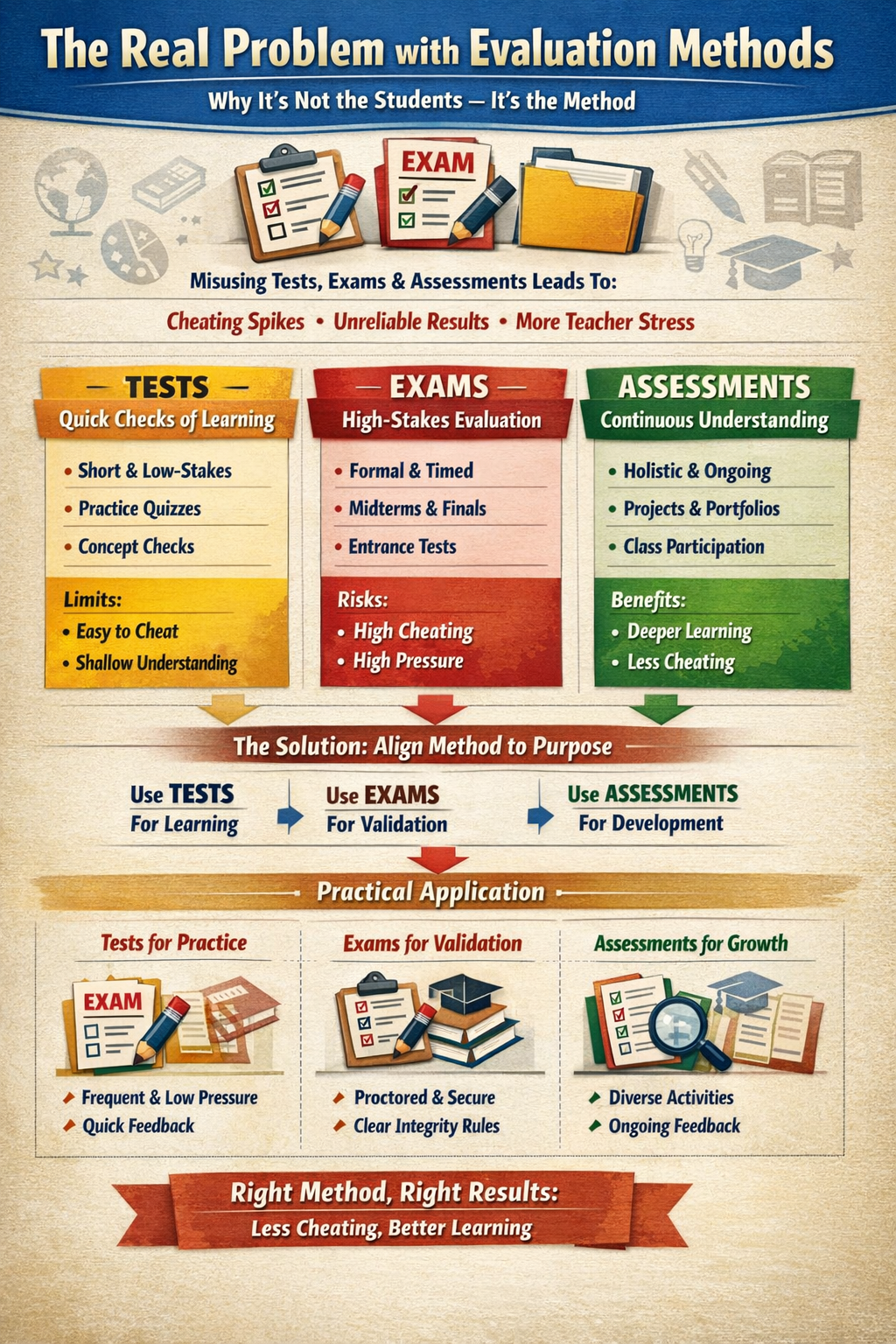
If you’ve ever wondered why students perform well in practice but struggle in finals, or why cheating spikes in some formats but not others, the issue is often not the students — it’s the choice of evaluation method.
Most classrooms use tests, exams, and assessments interchangeably. Research in Educational Assessment shows this leads to misaligned outcomes, higher anxiety, and unreliable measurement of learning.
This is not a theoretical problem. It directly impacts:
- Student honesty
- Learning depth
- Your workload as a teacher
The Core Distinction (What Research Actually Says)
1. Test → Quick Check of Learning
A test is:
- Short and focused
- Low-stakes
- Used during learning
Typical use:
- Weekly quizzes
- Practice questions
- Concept checks
Teacher dilemma it solves:
“Are my students actually understanding this topic right now?”
Limitation:
- Easy to cheat (especially on platforms like Google Forms)
- Does not measure deep understanding
2. Exam → High-Stakes Evaluation
An exam is:
- Formal and time-bound
- High-stakes
- Used for grading, promotion, certification
Typical use:
- Midterms
- Finals
- Entrance tests
Teacher dilemma it solves:
“Can I trust this score to represent real student ability?”
Reality:
- Without supervision, integrity drops significantly
- Research consistently shows unsupervised online exams have higher cheating rates
Implication:
- Exams require proctoring or controlled environments
3. Assessment → Continuous Understanding
An assessment is:
- Continuous and holistic
- Can include tests, projects, participation
- Focused on learning, not just scoring
Typical use:
- Assignments
- Projects
- Oral evaluations
- Portfolios
Teacher dilemma it solves:
“Are my students actually learning — not just memorizing?”
Research-backed insight:
- Continuous assessment improves retention and reduces academic dishonesty
- Students cheat less when evaluation is diversified
Why This Confusion Is Costing You
When all three are treated the same:
| What you use | What you expect | What actually happens |
|---|---|---|
| Google Forms quiz | Honest evaluation | Easy answer sharing |
| Final exam without proctoring | Fair grading | Inflated scores |
| Only exams | Deep learning | Rote memorization |
This mismatch creates:
- False confidence in student performance
- Increased cheating risk
- More re-teaching effort later
The Practical Fix (What Works in Real Classrooms)
A more effective structure:
Use Tests for Learning
- Frequent, low pressure
- Open-book where possible
- Immediate feedback
Use Exams for Validation
- Time-bound
- Proctored (AI or human)
- Clear integrity rules
Use Assessment for Growth
- Mix of assignments + participation
- Rubrics instead of only marks
- Iterative feedback
Tool Mapping (What to Use When)
| Need | Right Tool |
|---|---|
| Quick check (Test) | Google Forms |
| Secure evaluation (Exam) | Proctored platforms (e.g., MonitorExam-type systems) |
| Continuous learning (Assessment) | LMS + assignment workflows |
Final Insight
The problem is not cheating alone.
It is using the wrong evaluation method for the wrong purpose.
When you:
- Use tests to teach
- Use exams to validate
- Use assessments to develop
You get:
- More honest performance
- Better learning outcomes
- Less stress — for both you and your students
If You’re Facing This Right Now
If your current setup is:
- Students scoring too high online
- Difficulty tracking real learning
- Concerns about cheating
Then the fix is structural — not disciplinary.
Align the method to the goal, and the outcomes improve naturally.