Why We Started Supporting JEE Students?

India’s engineering entrance ecosystem is intense, high-stakes, and often unforgiving. Every year, over a million students prepare for one of the most competitive examinations in the country — the Joint Entrance Examination (JEE).
- Joint Entrance Examination (JEE Main & Advanced)
- Gateway to Indian Institutes of Technology (IITs)
- Pathway to National Institutes of Technology (NITs) and other premier institutes
We did not initially build for JEE. But over time, it became clear that JEE aspirants needed a fundamentally better assessment experience.
This is why we started supporting them.
1. The Gap Between Preparation and Reality
Most JEE preparation happens through:
- Offline mock tests
- Coaching centre evaluations
- PDF-based question banks
- Google Forms–style online tests
However, the actual JEE exam environment is:
- Strictly timed
- Technically controlled
- Psychologically demanding
- Computer-based
Students were preparing in environments that did not simulate real pressure.
We observed:
- Time mismanagement despite good conceptual clarity
- Score volatility across mock platforms
- Anxiety spikes during the real exam
The issue was not knowledge. It was assessment fidelity.
2. Fairness Is a Mental Health Issue
High-stakes exams amplify stress when:
- Students suspect others are cheating
- Online mock tests feel unreliable
- Rankings appear inflated
In hyper-competitive cohorts, perceived unfairness damages morale.
- A credible testing layer reduces:
- Rank distortion
- Comparison anxiety
- Performance doubt
Fair systems create psychological calm. Calm improves performance.
3. Data Depth > Just Scores
Traditional mock tests provide:
- Total marks
- Subject-wise marks
- That is insufficient.
Serious JEE preparation requires:
- Time spent per question
- Section switching patterns
- Guessing probability
Negative marking behavior
- Fatigue curve analysis
- Students need behavioral analytics, not just marks.
- When a student consistently loses marks in the last 30 minutes, that is not a syllabus problem — it is a stamina pattern.
4. The Digital Divide in Practice Quality
Top-tier coaching institutes run sophisticated test systems.
Many Tier-2 and Tier-3 students rely on:
- Basic platforms
- Unstructured mock papers
- No performance telemetry
The playing field is not level.
Technology can reduce that gap.
5. The Real Exam Is Computer-Native
JEE today is conducted online. Students must be comfortable with:
- On-screen numerical entry
- Navigation between sections
- Reviewing marked questions
- Working without physical question paper scanning
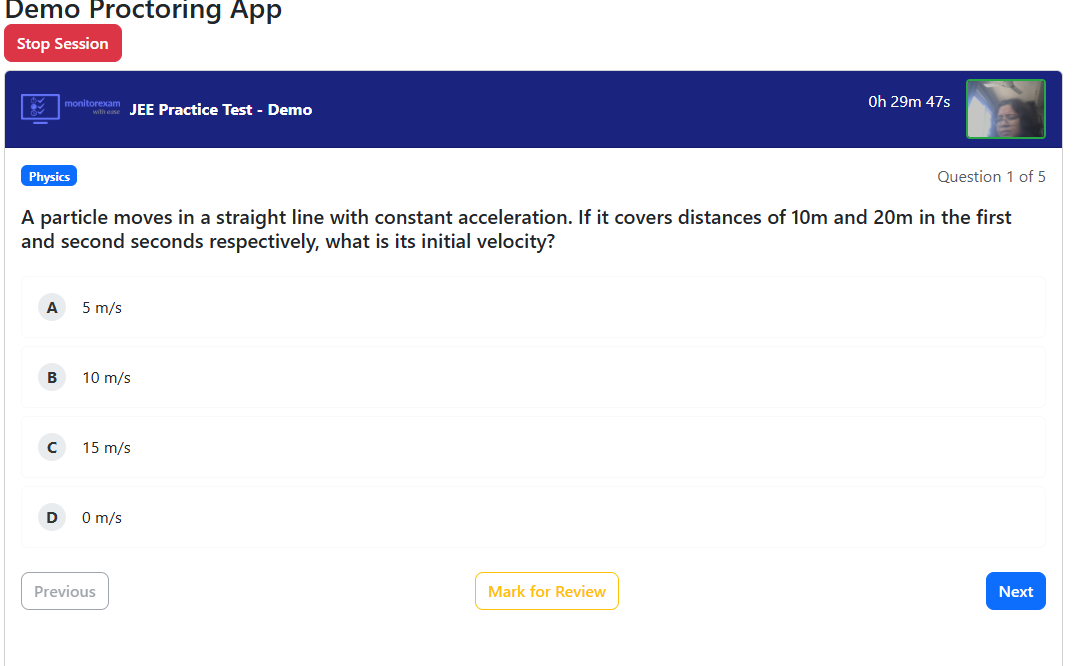
Practicing in pen-and-paper mode and appearing for a computer-native exam introduces friction. The interface matters.
6. Competitive Exams Demand Integrity
Even at the mock-test level, inflated scores create:
- False confidence
- Unrealistic percentile expectations
- Strategy distortions
A credible assessment environment ensures:
- Honest benchmarking
- Reliable percentiles
- Realistic AIR simulations
Students should compete on merit, not loopholes.
7. Why This Matters to Us
We believe assessments should:
- Be secure
- Be fair
- Be calming
Reduce noise in evaluation
JEE is not just another exam. It shapes:
- Academic trajectory
- Career direction
- Self-belief at 17–18 years of age
If technology can reduce uncertainty, improve realism, and create psychological safety, it should.
8. Our Commitment to JEE Students
Supporting JEE aspirants means:
- Simulating real exam conditions
- Delivering deep performance analytics
- Maintaining test integrity
- Reducing cheating distortions
- Helping students compete honestly
The goal is not to increase pressure. The goal is to remove artificial pressure.
When preparation becomes structured, secure, and measurable — effort translates more predictably into results.
Closing Perspective
The Joint Entrance Examination is one of the most demanding academic filters in the world. It deserves preparation infrastructure that matches its seriousness.
Supporting JEE students is not about entering a market segment.
It is about building systems where effort, not ambiguity, determines outcome.
We simulate the exact interface of a JEE sample test enabling student to use all the functionality optimally.