
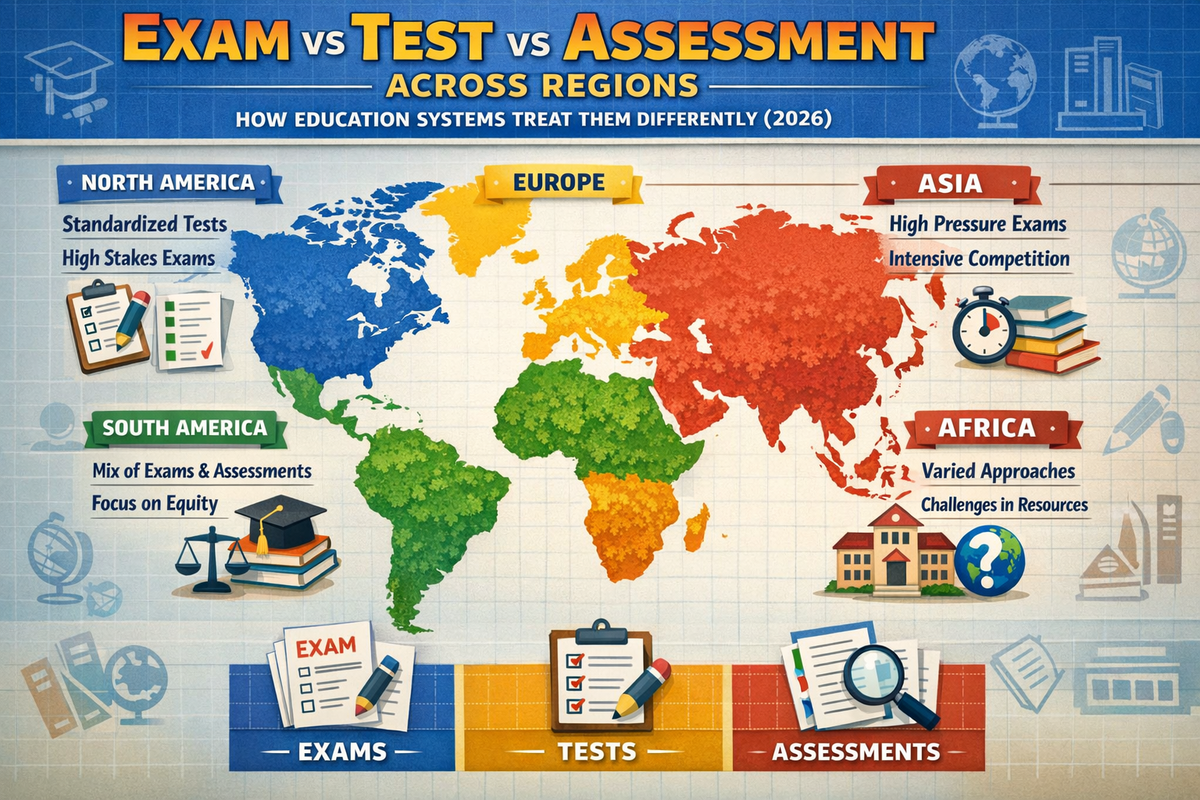
Exam vs Test vs Assessment Across Regions: How Education Systems Treat Them Differently (2026)
Exams run India and China. Assessments run Finland. The Philippines just went 100% online. Here's how 7 countries treat exams, tests and assessments — and what tools each one needs.
Updated June 2026 · 8 min read · MonitorExam
⚡ Quick Answer The terms exam, test, and assessment mean different things in different countries — and education systems are built around whichever one dominates. India and China are exam-centric. The USA and UK balance all three. Finland prioritises assessment over testing. The Philippines and Indonesia are rapidly shifting toward online exam delivery. Understanding these differences determines which tools work, which proctoring approach is appropriate, and how to design evaluation systems that work globally.
The words exam, test, and assessment are used interchangeably in everyday conversation. In education policy and academic research, they are not the same thing — and the distinction matters enormously depending on which country your institution is in.
These differences influence:
- How students prepare and how much stress they experience
- How teachers evaluate knowledge vs skills vs progress
- Which tools are appropriate — Google Forms, LMS platforms, proctoring software, or analytics dashboards
- How much integrity monitoring is required and at what stakes
For a complete breakdown of the core definitions, read the full guide:
 MonitorExam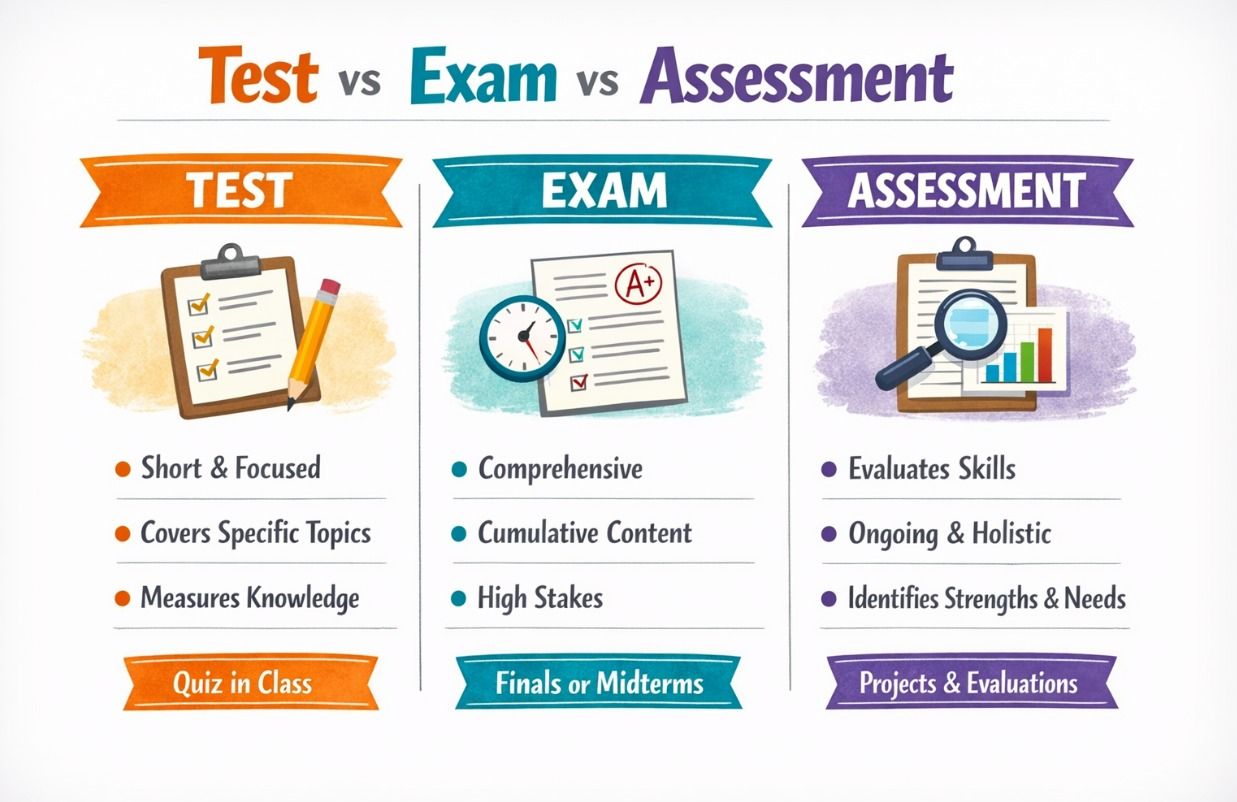
Global Snapshot — How Five Regions Compare
| Region | Primary focus | Exams | Tests | Assessments | Student stress |
|---|---|---|---|---|---|
| 🇮🇳 India | High-stakes outcomes | Dominant | Common | Limited adoption | High |
| 🇺🇸 USA | Balanced evaluation | Important | Frequent | Strong emphasis | Medium |
| 🇬🇧 UK | Structured progression | Standardised | Moderate | Integrated | Medium |
| 🇫🇮 Finland | Learning-first | Minimal | Minimal | Core system | Low |
| 🇨🇳 China | Exam = future | Extremely high | Secondary | Limited | Very high |
| 🇵🇭 Philippines | Shifting to online | Growing | Common | Increasing | Medium-high |
| 🇮🇩 Indonesia | Mixed system | Common | Frequent | Developing | Medium |
India — Exam-Centric System
Core mindset: Performance = Exam score
India's education system is built around high-stakes summative examinations. The board exam is the defining event of a student's academic career. The CBSE Class 10 and 12 board exams, taken by millions of students every February to April, carry life-determining weight — influencing university admissions, career paths, and family expectations simultaneously.
The competitive exam layer: Above the board exams sits a parallel world of entrance examinations — JEE for engineering (1.2 million candidates annually), NEET for medicine (2.2 million candidates), CUET for central university admissions, SSC for government employment, UPSC for civil services. These exams are not formative — they are eliminative. The gap between passing and failing determines decades.
What this means for tools:
- Google Forms and basic platforms are used for coaching tests and practice — low stakes
- Proctored platforms are used for competitive exams — maximum security required
- Continuous assessment barely features in most institutions
- Camera-optional proctoring is critical — bandwidth constraints in Tier 2 and 3 cities mean video-based monitoring is unreliable
The shift happening now: India's National Education Policy 2020 (NEP 2020) explicitly calls for moving away from rote memorisation toward competency-based assessments. Institutions aligned with NEP are adopting AssessME-style platforms that combine testing with analytics — but the competitive exam culture remains dominant.
USA — Balanced Evaluation System
Core mindset: Performance + Progress
The US education system deliberately distributes evaluation across all three forms. A typical university course includes weekly quizzes (tests), a midterm and final (exams), and ongoing project work, class participation, and assignments (assessments). No single event determines the outcome.
The standardised test layer: The SAT, ACT, AP exams, and GRE operate at higher stakes — but even here, most universities have moved toward test-optional admissions after COVID-19, reflecting a cultural shift away from single-score determination.
What this means for tools:
- LMS platforms (Canvas, Blackboard, Moodle) are dominant for quiz and test delivery
- Proctoring tools — Proctorio, Honorlock, MonitorExam — are used for high-stakes remote finals
- Analytics dashboards track student progress across all three evaluation types
- The US market specifically values: no browser extension, FERPA compliance, Canvas LMS integration
The shift happening now: Fall 2026 brings 4 million+ US university students back to campus from August 19 onwards. Remote finals in December remain the highest-demand period for proctoring tools. US institutions are actively evaluating Proctorio alternatives following cost and privacy concerns — blog below covers this directly.
 MonitorExam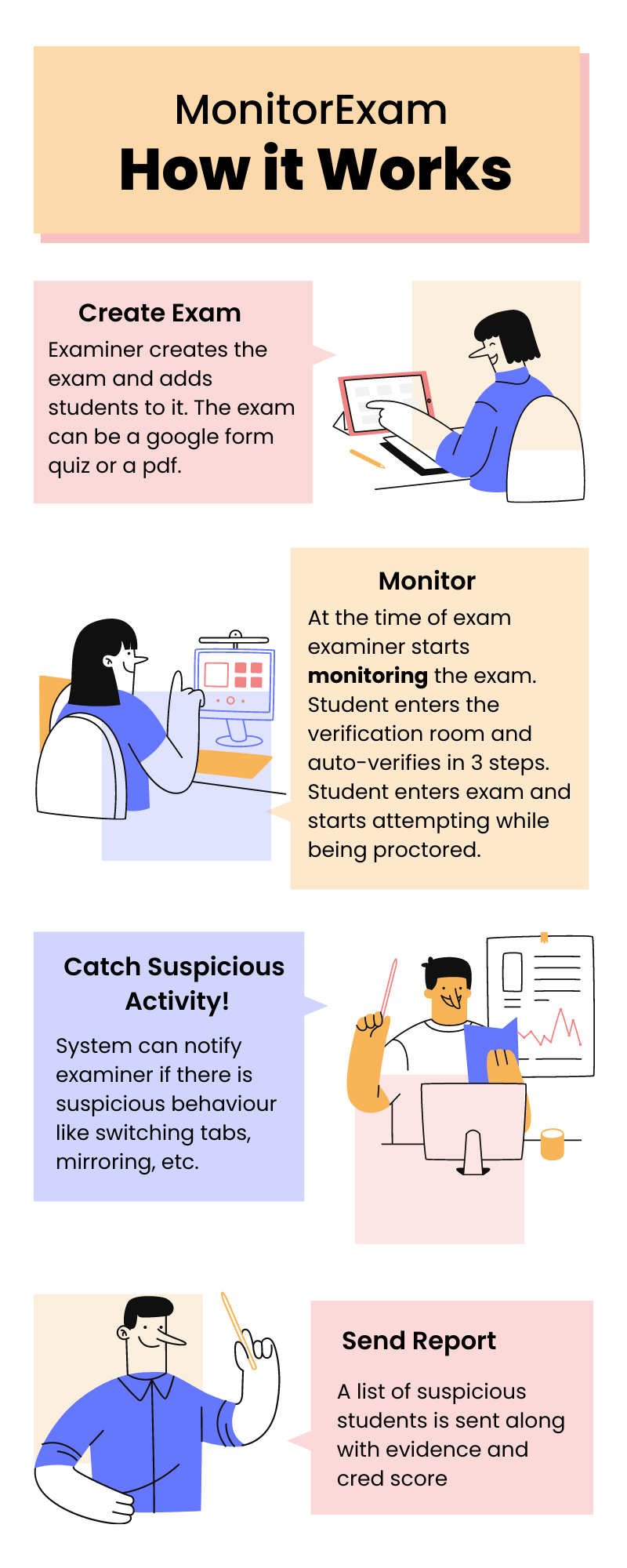
UK — Structured and Standardised
Core mindset: Measured progression through clear milestones
The UK system structures evaluation around formal milestones — GCSEs at 16, A-Levels at 18 — supplemented by coursework, teacher assessments, and moderated projects. The mix varies significantly between England, Scotland, Wales, and Northern Ireland.
What this means for tools:
- Controlled exam environments remain dominant for formal qualifications
- Teacher-led assessment is increasingly integrated, especially in Scotland
- EdTech adoption has accelerated post-pandemic, but institutional conservatism remains
- Ofqual-regulated assessments require documented integrity processes
The shift happening now: UK universities increasingly use hybrid assessment — online exams for objective components, submitted coursework for subjective. Proctoring tools that handle both types (automated for MCQ, human-reviewed for written) are gaining adoption.
Finland — Assessment-Driven System
Core mindset: Learning matters more than ranking
Finland consistently outperforms in international education rankings while running one of the lowest-testing education systems in the world. Students are not ranked against each other. Standardised testing is minimal. The national Matriculation Examination at the end of upper secondary education is the primary summative event.
What this means for tools:
- Formative assessment tools with feedback loops are the primary need
- Proctoring is a minor requirement — used only for the national exam
- Teacher professional development tools matter more than student monitoring
- Finland's model is increasingly being adopted by EdTech platforms globally as the framework for "calm assessment"
The MonitorExam connection: MonitorExam's calm assessment philosophy — security that fades into the background for honest students — is directly aligned with the Finnish principle that assessment should inform learning, not create fear. blog below covers this in detail.
 MonitorExam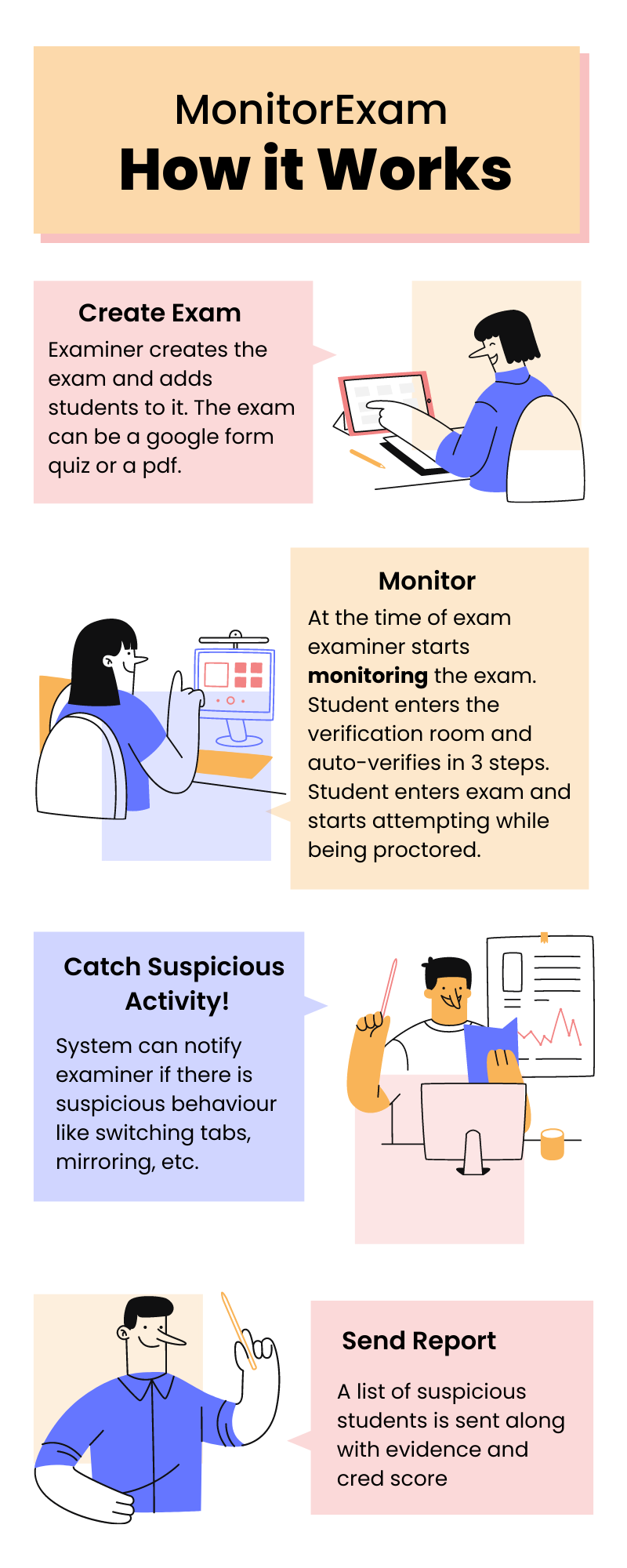
China — Exam-Oriented System
Core mindset: Exam = Future
The Gaokao — China's national college entrance examination — is arguably the highest-stakes single exam in the world. Taken by 13+ million students annually, it determines university placement with near-total finality. The entire secondary education system is structured around preparation for this one examination.
What this means for tools:
- Exam security technology is a priority at national scale
- Proctoring infrastructure is heavily government-standardised
- Facial recognition is widely deployed for identity verification
- Assessment beyond exam scores is limited in most traditional institutions
The shift happening now: Chinese EdTech has experienced regulatory restrictions since 2021, but institutional exam technology continues to grow. International universities operating in China require tools that meet both Chinese regulatory standards and international privacy frameworks.
Philippines — Rapidly Shifting to Online Delivery
Core mindset: Academic credentials + professional licensure
The Philippine education system runs on a two-semester academic year (August–May) with a strong emphasis on professional licensure examinations administered by the Professional Regulation Commission (PRC) — nursing, engineering, accountancy, teaching, and 40+ other professions.
The critical 2026 context: CHED has granted all higher education institutions the ability to shift to 100% online classes for AY 2025–2026 amid the ongoing oil crisis. CHED chair Prospero De Vera identified the core integrity challenge directly: "You don't know if the student is the one answering or someone else is answering for them."
What this means for tools:
- Online exam delivery is now mandatory for many institutions — not optional
- Identity verification is the primary integrity concern identified by CHED
- Low-bandwidth optimisation is essential — Philippine internet speeds are among the lowest in Southeast Asia
- Google Forms is widely used for course assessments due to its zero-cost accessibility
- Proctoring tools that work without requiring high-bandwidth video streaming are specifically needed
The procurement window: Philippine institutions are making tool decisions for AY 2026–2027 right now (June–July 2026). CHED will issue a new advisory before August. Institutions evaluating platforms during this window are making 1–3 year commitments.
Why MonitorExam is suited to the Philippines market:
- Camera-optional mode works on Philippine internet infrastructure
- Google Forms native integration — works with tools institutions already use
- Outcome-based pricing — institutions pay per exam delivered, not per seat
- FIDO2 passkey authentication directly addresses CHED's identity concern
- Free tier allows pilots without procurement budget approval
Indonesia — Mixed and Growing System
Core mindset: National standards + regional diversity
Indonesia's education system operates across 17,000+ islands with significant regional variation in infrastructure, teaching quality, and assessment practice. The national exam (Ujian Nasional) was suspended in 2021 as part of the Merdeka Belajar (Freedom to Learn) curriculum reform — a significant shift away from the high-stakes single exam model.
What this means for tools:
- Formative assessment tools are growing with the curriculum reform
- Google Forms usage is extremely high — widely used for teacher-created assessments
- Bandwidth constraints are significant — camera-optional proctoring is not optional
Detailed Regional Comparison
| Factor | India | USA | UK | Finland | China | Philippines | Indonesia |
|---|---|---|---|---|---|---|---|
| Exam importance | Very High | High | High | Low | Extremely High | High | Medium |
| Test frequency | High | High | Medium | Low | Very High | High | High |
| Assessment depth | Low | High | Medium | Very High | Low | Medium | Medium |
| Student stress | High | Medium | Medium | Low | Very High | Medium-High | Medium |
| Online exam adoption | Growing | High | Medium | Low | High | Rapid 2026 | Growing |
| Bandwidth constraints | Tier 2/3 cities | Low | Low | Low | Low | High | High |
| Language requirement | Hindi/English | English | English | Finnish | Mandarin | Filipino/English | Bahasa Indonesia |
What This Means for Assessment Tool Selection
| Region type | Primary need | MonitorExam fit |
|---|---|---|
| Exam-heavy (India, China) | Proctoring + secure exam platforms | ✓ Full proctoring spectrum from light to biometric |
| Balanced (USA, UK) | Test platforms + LMS integration + analytics | ✓ CredAPI for Canvas/Moodle + individual/group reports |
| Assessment-driven (Finland) | LMS + feedback systems | ✓ AssessME analytics layer |
| Low-bandwidth (Philippines, Indonesia) | Camera-optional + Google Forms compatible | ✓ Specifically designed for this |
| High-stakes licensure (Philippines PRC) | Identity verification + defensible audit trail | ✓ FIDO2 + CredScore |
The Global Trend: Assessment-Driven Learning Is Growing
Every education system listed above — including the most exam-centric — is showing movement toward more nuanced evaluation. NEP 2020 in India. Merdeka Belajar in Indonesia. Post-pandemic test-optional in the USA. CHED's online learning expansion in the Philippines.
The global trend is toward assessment systems that measure what students actually know — not just how well they perform under high-stakes pressure on a single day.
The timed tests and math anxiety research shows clearly: speed is a byproduct of fluency, not its foundation. Assessment systems designed around this principle produce better learning outcomes and more accurate qualification data.
MonitorExam's proctoring spectrum — from zero-friction quizzes to full biometric-verified examinations — is designed to support every point on this spectrum across every regional context.
Frequently Asked Questions
What is the difference between an exam and a test across countries? In most countries, an exam is a high-stakes formal evaluation at the end of a learning period that determines grades, qualifications, or progression. A test is a shorter, lower-stakes evaluation used during the learning period to monitor progress. The distinction is most pronounced in exam-centric systems like India and China, and least significant in assessment-driven systems like Finland.
Which country has the most high-pressure exam system? China's Gaokao system is widely considered the highest-stakes single-exam system globally, with 13+ million candidates sitting the exam annually. India's JEE Advanced and NEET UG come close — both are elimination-based examinations with acceptance rates under 5%.
How do Philippine universities conduct exams in 2026? Philippine universities are conducting exams online following CHED's advisory allowing 100% online classes for AY 2025–2026. The primary integrity challenge identified by CHED is identity verification — confirming that the registered student is actually taking the exam.
What is the best online exam tool for low-bandwidth countries? MonitorExam's camera-optional mode is designed for low-bandwidth environments. It proctors through browser lockdown, behavioural analytics, and session logs without requiring a stable video feed. It works on 2G connections and is used across the Philippines, Indonesia, India, and Africa.
How does Finland's education system avoid exams? Finland uses continuous teacher-led assessment as the primary evaluation method throughout schooling. The only significant national standardised exam is the Matriculation Examination at the end of upper secondary education. Finland consistently produces strong PISA outcomes despite — or because of — this minimal-testing approach.
Run Exams Globally — Any Region, Any Bandwidth
MonitorExam adapts to every regional context: exam-centric systems that need maximum security, balanced systems that need LMS integration, and low-bandwidth markets that need camera-optional delivery.
Free tier available. Setup in 5 minutes. Works with Google Forms.